
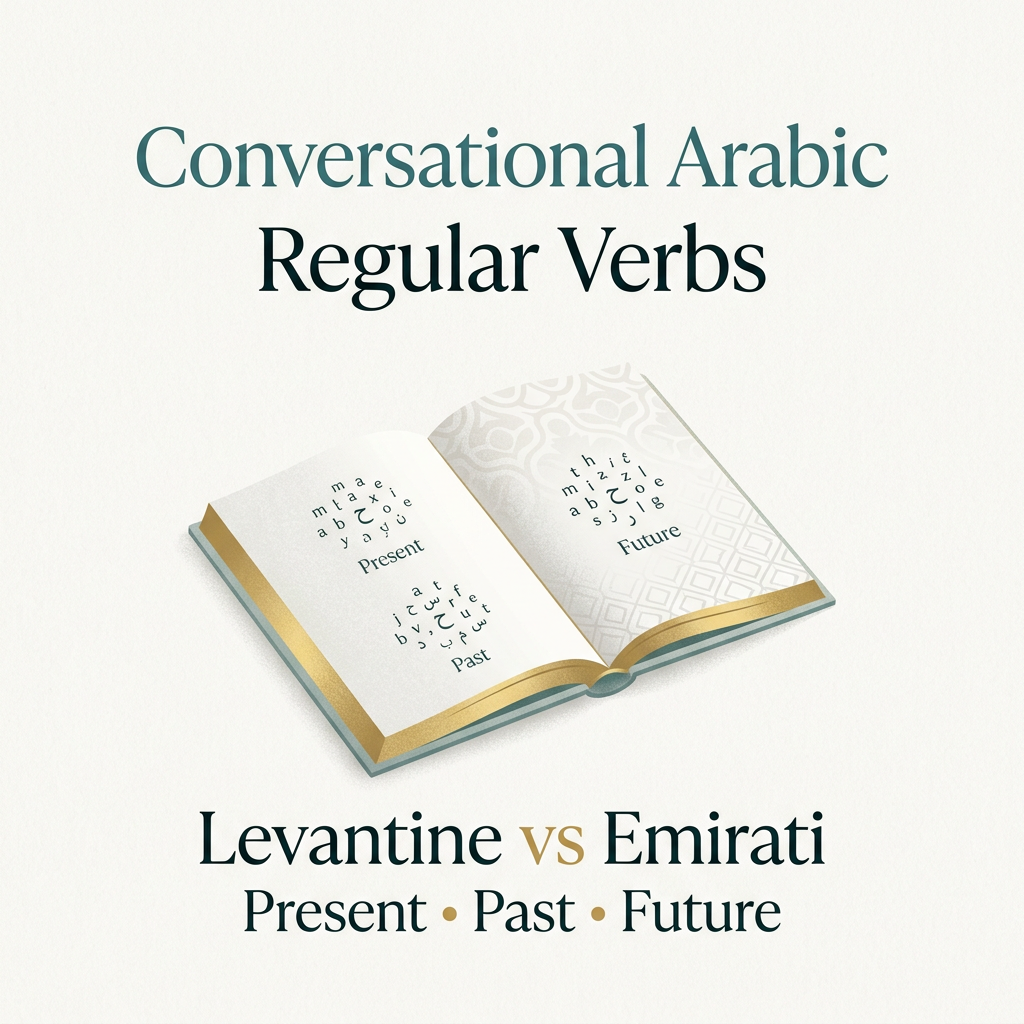
Levantine vs. Emirati Arabic Regular Actions & Verbs
AED 35.00
A practical guide to conjugating regular Arabic verbs in Levantine and Emirati Arabic. Learn how to form the present, future, and past tenses, understand the differences between the two dialects, and use two verbs together in everyday conversation.
Arabic verbs can look complicated at first, especially when you are learning a spoken dialect rather than Modern Standard Arabic. This lesson breaks the patterns down into clear, practical steps using one of the most useful everyday verbs: “to drink.”
You will learn how regular verbs are formed and conjugated in Levantine and Emirati Arabic, while seeing exactly where the two dialects are similar and where they differ.
What’s inside?
Present Tense
Learn how the present tense is built in each dialect, including the Levantine present marker and the Emirati structure without the same marker. The lesson also highlights differences in pronouns and endings, including forms for feminine and plural subjects.
Future Tense
Learn how to talk about future actions using different markers
You’ll see how these markers work with different pronouns and how the structure changes from the present tense.
Past Tense
Learn a practical method for building the past tense from the verb base, followed by a complete conjugation of “to drink.” The lesson also explains important Levantine vs Emirati differences.
Pronunciation Differences
Some dialect differences aren’t about grammar at all. You’ll learn how speakers may add an initial sounds to make certain words easier to pronounce.
When Two Verbs Come Together
Learn an important conversational pattern for sentences such as:
“I want to eat.”
“I liked to eat.”
The lesson explains which verb carries the tense in conversational Arabic.
Perfect for
- Learners of Levantine Arabic
- Learners of Emirati Arabic
- Students comparing the two dialects
- Learners who already know basic Arabic vocabulary
- Students who want to understand Arabic grammar without relying on MSA terminology
- Learners who want to move from memorising phrases to building their own sentences
What you’ll gain
By the end of the lesson, you’ll have a practical framework for recognising and producing regular Arabic verbs in the present, future, and past, while understanding the key differences between Levantine and Emirati Arabic.
The goal isn’t simply to memorise conjugations. It’s to help you recognise the patterns so you can apply them to other everyday verbs.


Reviews
There are no reviews yet.